Andalusia (Andalucía) is Spain’s southernmost and most populous autonomous region, famous for its rich Moorish history, vibrant flamenco culture, diverse landscapes from Costa del Sol beaches to Sierra Nevada mountains, and iconic landmarks like the Alhambra and Cordoba’s Mezquita and Cathedral. Its capital and largest city is Seville, and it’s divided into eight provinces, offering sunny climates, unique architecture, and delicious Mediterranean cuisine, attracting millions of visitors seeking culture, history, and natural beauty. Finding your way to the places in this blog are easy via public trains and for those looking for faster and more personal journeys hiring a private driver and guide who we’re worked with for many years.

Seville: The Gateway to the New World
Seville is the flamboyant, beating heart of Andalusia. After the Reconquista, it became the exclusive port for the “Indies”—the riches of the Americas flowed through the Guadalquivir River, funding the city’s opulent Gothic and Baroque skyline. It is a city of intense traditions, from the somber processions of Holy Week to the vibrant celebration of the April Fair.
The Cathedral & Giralda: A Monument to Grandeur
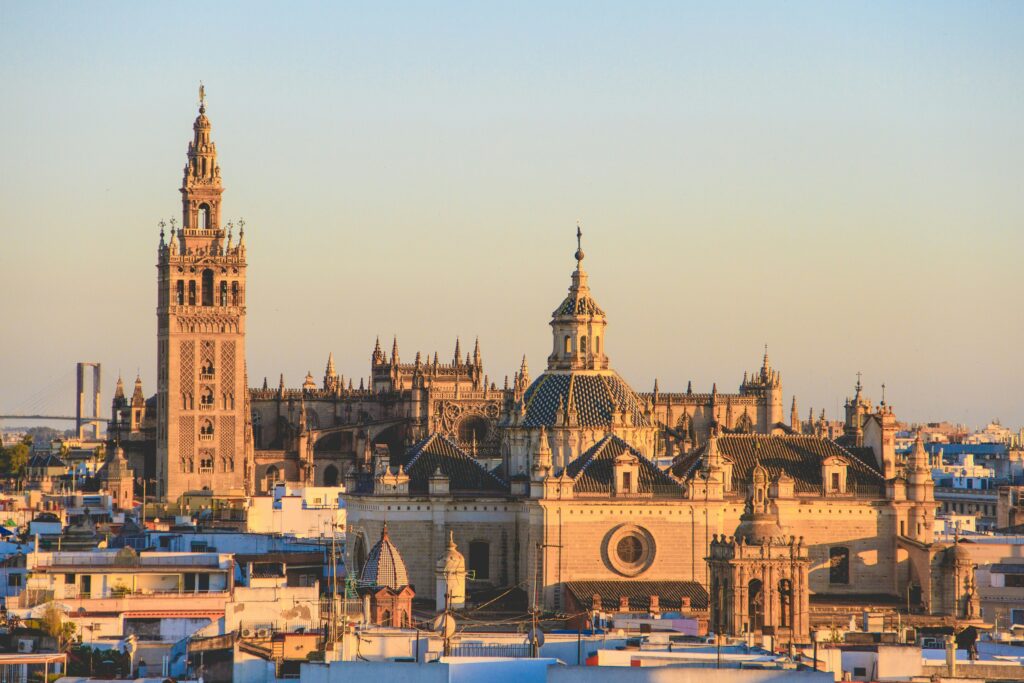
The Seville Cathedral is the largest Gothic church in the world, built with the explicit intention of demonstrating the city’s wealth and power. “Let us build a church so beautiful and so grand that those who see it finished will think we are mad,” the church elders reportedly said. It houses the monumental tomb of Christopher Columbus and an incredible collection of art.
The Giralda, the cathedral’s bell tower, was originally the minaret of the 12th-century Almohad mosque. Instead of stairs, it contains 34 ramps, designed so the Sultan could ride his horse to the top to enjoy the view and the call to prayer.
The Real Alcázar: The Palace of Kings
A stunning example of Mudéjar architecture, the Alcázar is the oldest royal palace still in use in Europe. It represents a unique cultural blend where Christian kings (notably Peter of Castile) employed Moorish craftsmen to create intricate plasterwork, tiled courtyards, and lush gardens. Its beauty is so otherworldly that it served as the filming location for the “Water Gardens of Dorne” in Game of Thrones.
Las Setas (The Mushrooms): Where Ancient Meets Avant-Garde
For a striking visual contrast to Seville’s medieval stone, head to the Plaza de la Encarnación to see Metropol Parasol, affectionately known by locals as Las Setas (The Mushrooms).
- The Architecture: Designed by German architect Jürgen Mayer and completed in 2011, this is the largest timber-framed structure in the world. Its “waffle” design of honey-colored birch wood looks like a giant, futuristic canopy growing out of the old city center.
- The Antiquarium: The structure was born from a happy accident. When the city began digging for an underground parking garage, they discovered extensive Roman and Visigothic ruins. Rather than paving over them, the city built Las Setas above them. You can now visit the Antiquarium in the basement to see preserved Roman mosaics and streets.
- The Mirador (The View): For photographers, this is the ultimate spot. An undulating walkway snakes across the top of the “mushrooms.” At sunset, the 360-degree view offers a perfect silhouette of the Cathedral’s Giralda against the burning Andalusian sky.
Triana: The Soul Across the River
Cross the iconic Isabel II Bridge to reach Triana, the traditional pottery and seafaring district. Historically home to the city’s Roma community, sailors, and master ceramicists, Triana feels like a separate village. This is where you find the soul of Seville’s ceramic culture (look for the beautiful “Azulejo” tiles) and the most authentic, unpretentious tapas bars.
Where to Stay in Seville
From historic mansions in the Jewish Quarter (Santa Cruz) to modern boutique hotels near the river, Seville offers some of the best hospitality in Spain.
Huelva: The Atlantic Gateway to Discovery
Tucked away in the far western corner of Andalusia, bordering Portugal and facing the open Atlantic, lies the often-overlooked province of Huelva. This is a land defined by brilliant light, expansive wetlands, and profound historical significance.
Huelva is famous as the launchpad for Christopher Columbus’s 1492 voyage to the Americas. Visits to the Wharf of the Caravels (Muelle de las Carabelas) allow you to step aboard full-size replicas of the Niña, Pinta, and Santa María, offering a tangible connection to the Age of Discovery.
Beyond history, Huelva is a paradise for nature lovers. It is home to the Doñana National Park, one of Europe’s most important wetland reserves, teeming with migratory birds and the elusive Iberian lynx. The coastline here is rugged and wild, offering pristine, endless beaches that feel worlds away from the crowded resorts further east. It is the perfect starting point for travelers seeking tranquility and historical depth before diving into the busier tourist hubs.
Cadiz: Ancient Charm on the “Coast of Light”

Moving southeast along the Atlantic coast, you arrive at Cadiz. Often cited as the oldest continuously inhabited city in Western Europe, Cadiz is a shimmering jewel perched on a narrow slice of land surrounded almost entirely by the sea.
Entering the old city feels like stepping back in time. The streets are a tight labyrinth opening onto bright, buzzing plazas. The city skyline is dotted with over 100 watchtowers, remnants of its mercantile golden age, with the Tavira Tower offering the best panoramic views.
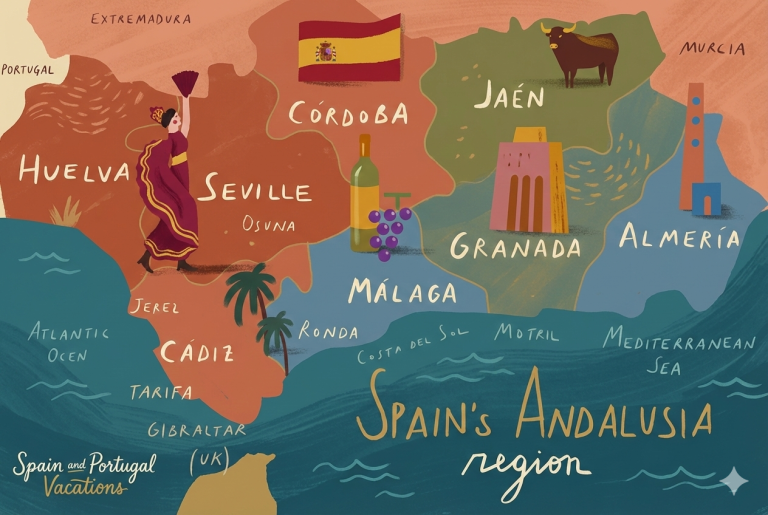
Cadiz is the heart of the “Costa de la Luz” (Coast of Light). The atmosphere here is relaxed, briny, and incredibly welcoming. It is a place to indulge in fried fish delicacies at the central market, walk along the fortified sea walls of La Caleta beach, and soak in a sunset that seems to burn passionately into the ocean. Just north of the city lies the region famed for Sherry production, highlighted by the grapes and wine bottle on our Andalusian map, making Cadiz the perfect base for oenophiles.
Malaga: The Vibrant Capital of the Costa del Sol

Rounding the southern tip of Spain and entering the Mediterranean, you reach Malaga. Once considered merely a gateway airport to the beach resorts of the “Costa del Sol,” Malaga has reinvented itself into one of Spain’s most dynamic cultural hubs.
As the birthplace of Pablo Picasso, art is central to the city’s identity. The Picasso Museum, housed in a beautiful 16th-century palace, is a must-visit. But Malaga wears its ancient history proudly, too. The massive Alcazaba, a palatial Moorish fortification, stands guard over the city, connected to the higher Gibralfaro Castle offering sweeping views of the port.
Malaga strikes a perfect balance. You can spend the morning exploring Roman theaters and Moorish palaces, the afternoon sunbathing on urban beaches like La Malagueta, and the evening hopping between tapas bars in a city center that buzzes with life until the early morning hours.

Granada: The Moorish Jewel beneath the Sierra Nevada
Heading inland from the coast, the landscape rises dramatically toward Granada. Nestled at the foot of the soaring Sierra Nevada mountains, Granada is perhaps the most romantic and evocative city in all of Spain. It was the last stronghold of the Moorish kingdom in Western Europe, a legacy that defines its soul to this day.
The crown glory of Granada is, undeniably, the Alhambra. This sprawling complex of palaces and fortresses is the pinnacle of Islamic art and architecture in Europe. Its intricate stucco work, serene courtyards like the Patio of the Lions, and the lush gardens of the Generalife are breathtakingly beautiful.
But the magic extends beyond the Alhambra walls. Across the Darro valley lies the Albayzín, the ancient Arabic quarter. It’s a steep tangle of narrow, winding cobbled streets and white-washed houses leading to miradors (viewpoints) like San Nicolás, where you can watch the sunset turn the Alhambra shades of violent red and orange. Granada is also famous for its enduring free tapas culture—buy a drink, and a small plate of food arrives gratis.
Almeria: Desert Landscapes and Cinematic Shores
Further east, the landscape shifts again as you enter the province of Almeria. This is perhaps the most enigmatic corner of Andalusia, known for having the driest climate in continental Europe.
This unique climate has created Europe’s only true desert, the Tabernas Desert. Its striking, barren landscapes look straight out of the American Wild West, which is exactly why hundreds of “Spaghetti Westerns” were filmed here in the 1960s and 70s.
Yet, Almeria is also home to the Cabo de Gata-Níjar Natural Park. This protected stretch of volcanic coastline offers some of the Mediterranean’s most spectacular and unspoiled beaches. The city of Almeria itself is dominated by its own impressive Alcazaba, the second largest Muslim fortress in Andalusia after the Alhambra, offering a glimpse into the region’s strategic importance throughout history.
Jaen: The Kingdom of Olive Groves

Moving north into the interior, you enter the province of Jaen. If you look at the provided map, the area around Jaen is colored in earthy olive tones. This is no coincidence. Jaen is the undisputed world capital of olive oil production. As you drive through this region, you will be greeted by a veritable sea of olive trees covering every rolling hill as far as the eye can see—an estimated 60 million trees in total.
The city of Jaen is steeped in history, overlooked by the imposing Castillo de Santa Catalina. The city is a treasure trove of Renaissance architecture, most notably its massive cathedral, which aspired to rival the greatest churches in Christendom. A visit to Jaen is a deep dive into rural Andalusian culture, where liquid gold—olive oil—is a way of life.
Cordoba: A Testament to Imperial Grandeur
Completing our loop through the Andalusian interior is the magnificent city of Cordoba. In the 10th century, Cordoba was the largest and most advanced city in Western Europe, a beacon of learning and tolerance under the Caliphate.
That glorious past is best embodied by the Mezquita-Catedral (Mosque-Cathedral). It is an architectural hybrid of staggering beauty. Walking into its vast prayer hall, filled with hundreds of candy-cane striped arches made of jasper, onyx, marble, and granite, is a humbling experience. In the 16th century, a Renaissance cathedral nave was constructed right in the center of the mosque, creating a unique, if controversial, juxtaposition of faiths.
Surrounding the Mezquita is the charming Jewish Quarter (Judería), a network of narrow streets, whitewashed walls with flower-filled balconies, and quiet patios. A walk across the ancient Roman Bridge at dusk, looking back at the city bathed in golden light, is the perfect way to end your Andalusian odyssey.
Seville welcomes visitors year round although many avoid the months of July and August due to high temperatures in the summer months and during the winter months of December and January when cold weather is the norm.
Get in touch to experience Seville as part of your Spain and Portugal Vacation curated to your style of travel by our experts.
Contact Us to Plan Your Dream Trip to Spain and Portugal