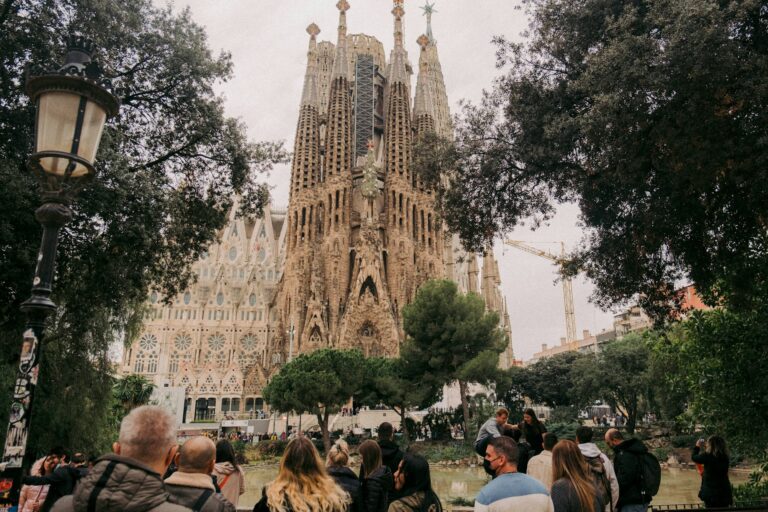
Sagrada Familia has been under construction since 1882, and has become a symbol of Barcelona’s cultural identity. The architect Gaudi’s vision is what you see today; from 1887 until he passing in 1926 several areas were finished but only the Saint Barnabas bell tower on the Nativity facade was completed during his lifetime. From 1926, various architects have worked to fulfill his vision, notwithstanding severe setbacks suffered during the Spanish Civil War and periods without adequate funding.
This is the story behind Barcelona’s most famous attraction, why it remains one of the top things to see in Spain, and continues to inspire travelers from around the world to witness in person the last great cathedral being built in Europe.
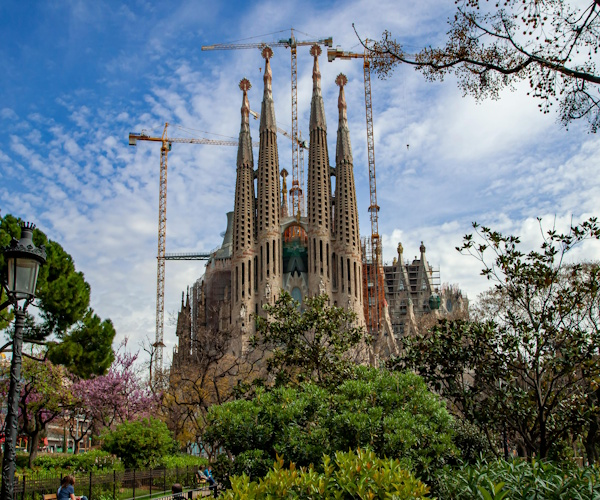
Unlike the rest of Europe’s great basilicas and cathedrals like Notre Dame in Paris, Reims and Chartres in France, Westminster and Salisbury in the United Kingdom or Saint Peter’s in Rome, which were completed centuries ago (often after hundreds of years of construction), the Sagrada Família is remarkable for being the only great church built in the style of those great constructions and uniquely in Europe still under active construction. Its first stone was laid in 1882, and since then, generations of architects, artisans, and builders have continued the work started by Antoni Gaudí. In 2026, the basilica is slated to be formally finished consecrated by Pope Leo XIV, making him only the fourth pope to have visited the basilica since its inception.
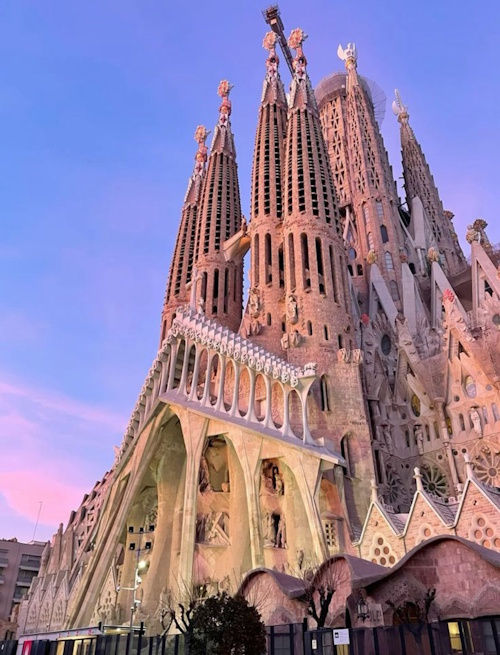
The Sagrada Família is composed of multiple towers, each with symbolic dedication. When completed, the basilica will feature 18 towers: 12 representing the Apostles, four for the Evangelists, one for the Virgin Mary, and the tallest for Jesus Christ. The Tower of the Virgin Mary was finished in 2021 and is crowned with a twelve-pointed star, illuminating the city at night. The Tower of Jesus Christ, which will reach 172.5 meters, will be the tallest religious tower in Europe upon completion, and construction continues with new phases announced for 2025 and 2026, including the addition of external coverings and sculptural details on the upper sections.
Stained Glass Use In The Basilica of Sagada Familia
Stained Glass Magic
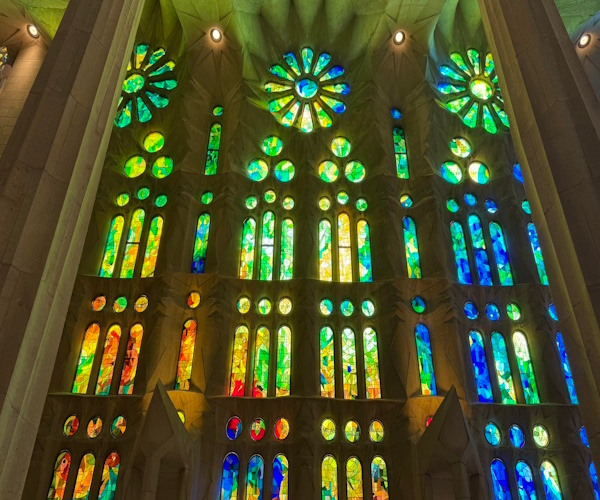
The windows flood the inside with color that changes with the sun. East side starts with cool blues and greens in the morning; west side hits with warm reds and oranges later. Artisans like Joan Vila-Grau followed Gaudí’s plans to make light dance over tree-like stone columns. It softens shadows and ties the space to the outdoors. This builds on old cathedral tricks—filtering harsh light and telling stories through pictures for folks who couldn’t read.
The basilica was designed so that daylight would enter through carefully positioned stained glass windows, transforming the interior atmosphere throughout the day. Mornings bring cooler tones of blue and green through the eastern windows, while the western side introduces warmer reds and oranges in the afternoon. This gradual shift in color alters the perception of space, highlighting columns, vaults, and sculptural details at different hours. Stained glass has long been used in religious architecture not only for visual effect but also for symbolic and practical reasons. In medieval cathedrals, it filtered intense sunlight, reduced glare, and conveyed biblical narratives to largely illiterate populations through imagery and color. At the Sagrada Família, this tradition continues in a contemporary form and by utilization of columns that add dimension and perspective.
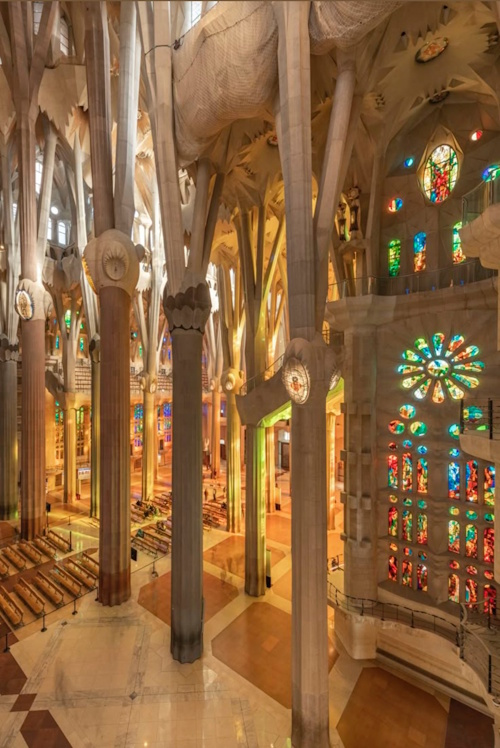
The glass diffuses light across the interior, softening shadows and emphasizing the branching stone columns inspired by natural forms, the result is an interior where illumination is not static. As the sun moves, the colors shift across the stone surfaces, reinforcing the architectural geometry and maintaining a direct relationship between the exterior environment and the interior space.
Key Milestones During Gaudi’s Lifetime
-
- The Crypt (completed 1880s–1890s): Built largely following the earlier Neo Gothic plan, but modified by Gaudí. It remains the structural and spiritual foundation of the basilica and is where Gaudí is buried.
-
- The Apse and Ambulatory: These elements established the vertical rhythm and structural logic that would define the rest of the church.
-
- The Nativity Façade (substantially completed by 1930): The only façade largely realized according to Gaudí’s detailed direction and surviving plaster models. It is characterized by dense sculptural ornamentation and organic forms inspired by nature.
-
- The First Four Apostles’ Towers on the Nativity side: These towers demonstrated Gaudí’s evolving structural solutions and decorative language.

Interruption and Reconstruction
During the Spanish Civil War in 1936, parts of Gaudí’s workshop were destroyed, including many original drawings and plaster models. Later architects reconstructed these materials from surviving fragments and photographs. This required both interpretive skill and technical analysis to ensure fidelity to Gaudí’s geometric principles. Each major phase since Gaudí’s death has been overseen by different chief architects responsible for continuing to follow Gaudi’s vision.
-
- Domènec Sugrañes i Gras (1926–1938), who completed work on the Nativity towers.
-
- Francesc de Paula Quintana and successors (mid 20th century), who focused on structural consolidation and reconstruction of Gaudí’s models.
-
- Jordi Bonet i Armengol (1980s–2012), under whom major interior vaulting and nave columns were completed.
-
- Jordi Faulí (2012–present), who has overseen the completion of the nave, the consecration of the basilica in 2010 by Pope Benedict XVI, and the ongoing construction of the central towers.

Interior Completion and Recent Milestones
The nave and interior vaults were completed in the early twenty first century, allowing the basilica to function fully for worship. The Tower of the Virgin Mary was completed in 2021, crowned with a large illuminated star. Current efforts focus on the central Tower of Jesus Christ, which will rise to 172.5 meters and become the tallest church tower in Europe.
Each construction stage reflects the tools and methodologies available at the time. Early phases relied almost entirely on hand carving and analog modeling. Contemporary work incorporates computer aided design, 3D scanning of surviving models, and precision stone cutting technologies. Despite technological evolution, the execution still depends on skilled artisans capable of translating digital plans into durable stone, ensuring structural integrity and visual continuity.
Practical Information for Visitors
Visiting Sagrada Família with a local guide is often the most rewarding way to experience this iconic basilica. Local guides bring deep knowledge of the site’s history, symbolism, and ongoing construction, sharing stories and details that most visitors would miss on their own. This expert insight not only enriches your understanding of the architecture and artistry but also maximizes your time—guides can narrate as you move through the site so you absorb more without needing to stop and read every sign or search for explanations.
Another advantage is efficiency. Entry tickets for Sagrada Família can be difficult to secure online, especially during peak travel seasons or holidays, as official tickets often sell out weeks in advance. Professional guides typically have access to a dedicated reservation app, giving them real-time ticket availability and priority entry slots that aren’t always visible to the general public. This means even last-minute visitors can often secure a spot through a guided tour, bypassing the disappointment of sold-out public slots.
It’s important to be cautious about where you purchase your entry. Many third-party sites advertise tickets to Sagrada Família, but some do not have official partnerships and may not actually have the tickets they promise. Purchasing from such sources can lead to cancellations, overpricing, or even scams. For peace of mind and the best experience, it’s wise to book directly with official providers or established local guides.