The Kingdom in Peril: A King’s Great Choice
In the year 1383, the very soul of Portugal trembled. King Ferdinand had died without a son, and a shadow fell over the land. His only daughter was married to the King of Castile, a powerful neighbor who viewed the Portuguese border as nothing more than a line to be erased. This was the “dynastic crisis”—a time of shimmering heat, clashing steel, and a country on the brink of vanishing forever.
But Portugal would not go quietly. A leader rose: D. João I, the Master of Avis. He was not alone in his struggle; he was guided by the wisdom of his chancellor, Dr. João das Regras, and his confessor, Friar Lourenço Lampreia. Together, they faced a giant challenge. As the massive Castilian army marched toward them, D. João I knew that courage alone might not be enough. On the eve of a battle that would decide the fate of millions, the King knelt in the dust, the shadow of war looming over him, and whispered a desperate plea to the heavens.
The King’s Plea was not recorded and lost to history, but he was extremely religious and believed in the Virgin Mary and is traditionally said to have placed his cause under the protection of the Virgin Mary and vowed to build a monastery if Portugal prevailed.
This connection between the monarchy and Marian devotion was strengthened by the religious order João I placed at Batalha: The Dominican Order, which had a long tradition of promoting devotion to Mary. This fact will play an integral part of the story of Batalha for centuries to come, as the Dominicans would inhabit Batalha for more than 450 years, until the dissolution of religious orders in the 1830’s.
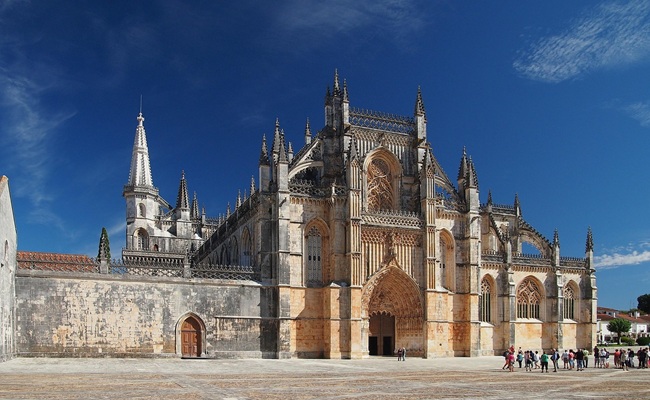
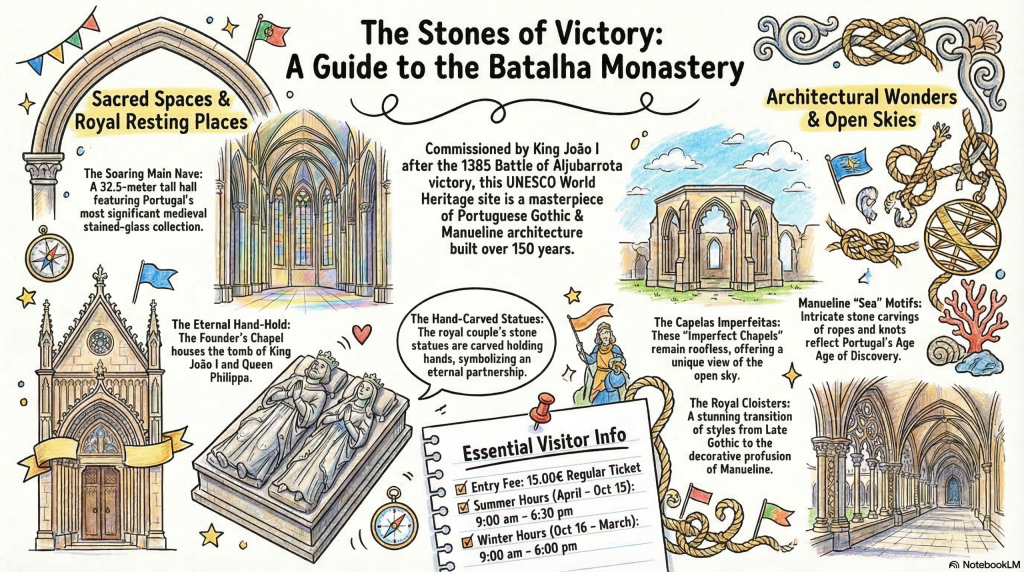
After the unexpected Portuguese victory, João I fulfilled that vow by founding the Monastery of Batalha in 1386. The monastery was officially dedicated to Santa Maria da Vitória — Saint Mary of the Victory, explicitly linking the triumph in battle with Marian intercession.
With this heavy promise weighing on his heart, the King’s focus shifted from the sword to the chisel, leading his men toward a dusty battlefield that would change the history and trajectory of power and statehood in the Iberian Peninsula forever. The Monastery of Batalha was therefore the start of the period of Portugal’s history and through his marriage to Philippa of Lancaster, an English-born Queen Consort of Portugal from 1387 to 1415, King John I sealed the Treaty of Windsor and cemented the enduring Anglo-Portuguese Alliance. Renowned for her education, piety, and diplomacy, she influenced court culture, advanced trade, and raised the ‘Illustrious Generation’ of rulers, explorers, and scholars—shaping Portugal’s Golden Age and paving the way for the Age of Discoveries.
The Royal Pantheon: A Forever Home for Kings
Batalha was designed with a dual purpose: it was a “Thank You” to the Virgin Mary and a Royal Pantheon—a final, sacred resting place for the dynasty born on the battlefield.
When you step into the Royal Chapel is over stones worn down by centuries of pilgrims and monks who prayed here daily for centuries. In the center are the Royal Tombs of King Joao and Phillipa of Lancaster with their hands holding one another’s, held aloft by carved stone lions in a magnificent Gothic tomb that shows signs of damage caused by the devastating 1755 earthquake and looting by troops of Napoleon’s invasion of Portugal in the early 1800’s.
-
- The World-Class Windows: Vibrant stained glass in the Chapel and Chapter Hall that has survived for centuries.
-
- The Hand-Holding Statues: In the Founder’s Chapel, you can see the tomb of King João I and Queen Philippa. Their stone statues are carved holding hands—a symbol that their partnership lasted even beyond death. The coffins rest on stone lions which some legends say were only used for holding aloft the tombs of Kings and Queens. We know for certain these were part of the original funerary monument.
-
- First Steps Into the Founder’s Chapel: The stone has literally been worn down by the feet of thousands of pilgrims that for centuries came to the Batalha Monastery for their devotion to the Marian Beliefs and honoring the King and Queen of Portugal.
The Architectural Majesty of the Monastery
This historic site stands as a masterclass in monumental architecture, anchored by a magnificent Church that soars $32.5\text{ meters}$ into the sky, its grand weight borne by a striking avenue of eight columns on either side. Beyond the main sanctuary lie two tranquil cloisters and a series of breathtaking chambers that chronicle both royal legacy and artistic genius.
Highlights of the Complex
-
The Founder’s Chapel: Serving as the Royal Pantheon, this sacred space was envisioned by the brilliant Master Huguet. It serves as the eternal resting place for King João I, Queen Philippa of Lancaster, and their celebrated children, historically known as the Illustrious Generation.
-
The Unfinished Chapels: Famous for their raw, evocative beauty, these structures are defined by a spectacular entrance portico showcasing the intricate, sea-inspired details of the distinctively Portuguese Manueline style.
-
The Chapter House: Another architectural triumph by Master Huguet, this room features a mesmerizing star-vaulted ceiling. It carries profound national significance, housing the Tomb of the Unknown Soldier from World War I since April 9, 1921. To this day, visitors can witness the solemn, daily Changing of the Guard ceremony honoring these fallen heroes.
-
The High Chapel & Chapter Stained Glass: Illuminating the stone interiors is the timeless, ethereal glow of vibrant stained-glass windows, which have cast their colorful light across the chapels since 1514.
-
- First Steps Into the Founder’s Chapel: The stone has literally been worn down by the feet of thousands of pilgrims that for centuries came to the Batalha Monastery for their devotion to the Marian Beliefs and honoring the King and Queen of Portugal.
Visiting Batalha
Batalha is about 120 km north of Lisbon and can be visited as a day trip or a longer stay to explore the central region.
The town is small and walkable, with restaurants and accommodations catering to tourists. It is also close to other historical towns like Alcobaça, Óbidos, Tomar, and the coastal towns of Peniche and Nazaré, making it ideal for combined sightseeing Day Trips from Lisbon and Portugal or part of multi-day vacations planned by our professional travel consultants with more than two decades of experience designing Portugal and Spain adventures.
Festivals and Local Culture
Near to Batalha is the small village of Reguengo do Fetal where a procession that is lit by thousands of snail shells lining the streets. Time your visit to witness this amazing ancient religious festival in Portugal.
Festivities of Nossa Senhora do Fetal. According to local legend, devotion to Our Lady of Fetal is due to a young shepherdess who was herding cattle and crying because she was hungry. Our Lady appeared to her and sent her to ask her mother for bread: “Tell her that a woman sent you to tell her that there is bread in the ark”. The ark, which had been empty, was miraculously filled with bread. The processions take place at night, using thousands of snail shells, which are soaked in olive oil, twisted with string to act as a wick and which, once lit, give a unique visual effect.The first procession, after the public lighting switch-off, takes the image of Our Lady of Fetal from the shrine of the same name to the parish church. The following Saturday, the procession is repeated, but in the opposite direction.
- The preparation of the thousands of snail shells used in the processions involves the voluntary labor of around 200 people from the village of Reguengo do Fetal, ranging from kindergarten children to users of the village’s old people’s home.
- Noteworthy is the involvement of the parish’s emigrants, with a strong presence in the United States of America, who return to their home village around the time of the festivities and take an active part in the decorations.