Born into poverty with six fingers on each hand, Brites was a woman of immense strength and legendary temper. Born around 1350 in Faro, Algarve, legend says she was a woman of immense physical strength, born with six fingers on each hand. She was known for her fierce and independent spirit, often dressed in men’s clothing to work as a baker. Her life was marked by adventure and tragedy long before the battle of Aljubarrota that took place in the year 1385 on a battlefield located less than 2 kilometers from the Basilica of Batalha in the town of Batalha in Portugal.
In Portugal, that figure is Dona Brites de Almeida.
Known to every Portuguese schoolchild as the Padeira de Aljubarrota (the Baker of Aljubarrota), Brites is not just a folklore character. She is the embodiment of common resistance, a symbol of the povo (the people) rising up to defend their soil. Her legend is inextricably linked with the Battle of Aljubarrota in 1385—the defining moment that secured Portugal’s independence from Spain.
This is the story of a towering crisis, a brilliant dynamic duo of leaders, a vastly outnumbered army, and a sturdy woman with a very heavy wooden shovel.
The Cauldron of Crisis: 1383–1385
In 1383, King Fernando I died without a male heir. His daughter, Beatrice, was married to King Juan I of Castile (modern-day Spain). Under the marriage treaty, this effectively meant Portugal would be annexed by the Castilian crown. The Portuguese nobility was divided, but the common people and the merchant class recoiled at the idea of losing their independence. A rebellion ignited, centered around João, the Master of Aviz, an illegitimate half-brother of the dead king. In April 1385, the Portuguese Cortes (assembly) declared João as King João I of Portugal.
Juan I of Castile did not take this news well. He viewed João as a usurper and Portugal as his rightful property. Seizing the opportunity to crush Portuguese resistance once and for all, the Castilian King gathered an overwhelming invasion force. commonly described as a very large army of about 20,000 to 32,000 men, depending on the source, with some accounts pushing it higher when support troops are included, among them French troops, Aragonese, Italian, and other mercenary forces.
The Portuguese force was much smaller, usually given as about 6,500 to 7,000 men, with English longbowmen helping as part of the alliance with Portugal. That huge imbalance is why the Portuguese victory at Aljubarrota became so famous: they defeated a far larger invading army and secured Portugal’s independence from 1385 until the union of Portugal and Spain from 1580 to 1640.
The Portuguese won a decisive victory against the Castilian forces in 1385 at the Battle of Aljubarrota but in their disorganized defeat and retreat, many Castilian soldiers fled the battlefield and this is where the legend of Dona Brites de Almeida begins, and some soldiers story ended !
Enter Dona Brites: The Legend is Born
The battle was won, but the danger was not entirely over. In the chaotic aftermath, hundreds of Castilian soldiers fled the field, scattering into the surrounding hills and villages, looking for food, horses, or a place to hide before regrouping or trying to make it back to the border.
This is where history fades into the beautiful, fierce light of legend.
In the small village of Aljubarrota, life was slowly returning following the noise of battle. Among the villagers was a woman named Brites de Almeida.
Legend describes Brites as anything but delicate. She was said to be a robust, tall, and exceptionally strong woman, possessed of a fiery temper and the sturdy build of someone who spent her life working the dough in her bakery. Some variations of the story even imply she had a somewhat rough-and-tumble past, having lived a life of travel and adventure before settling down to bake.
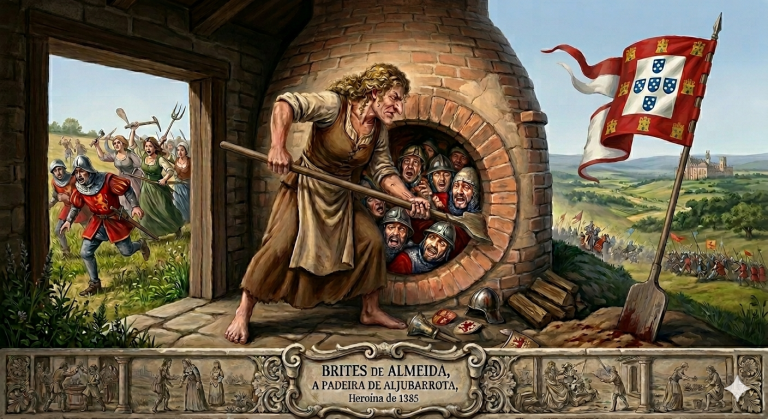
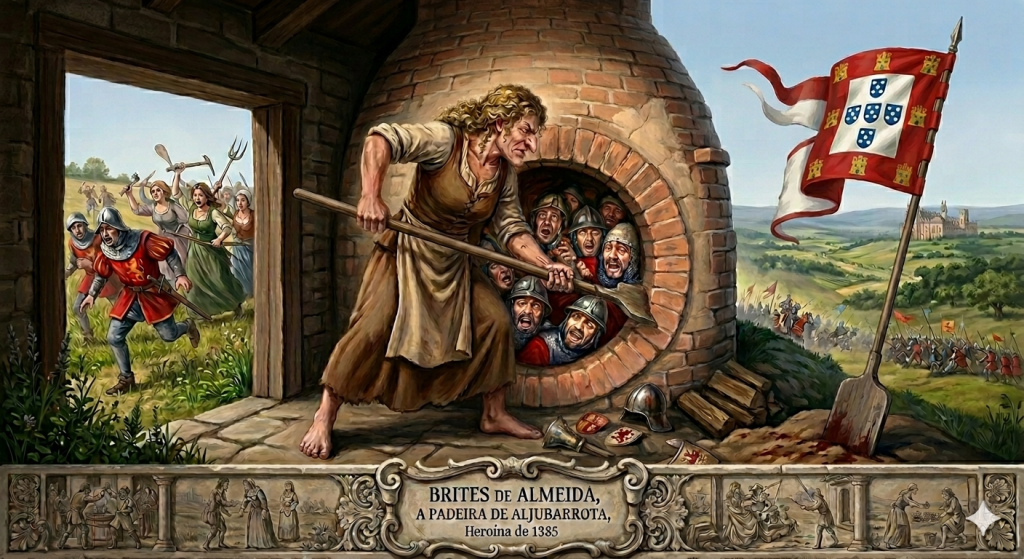
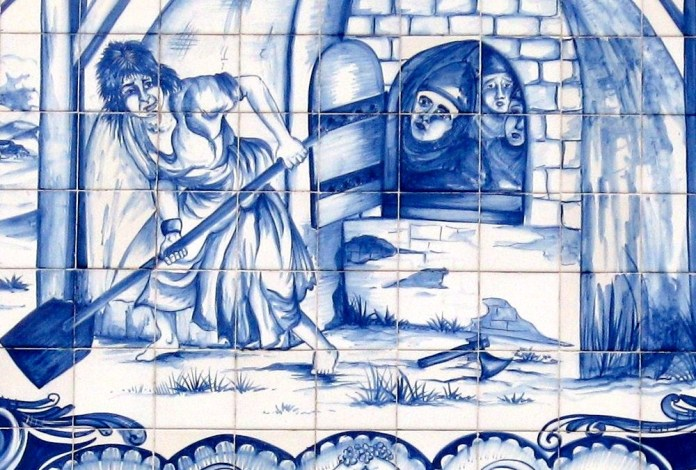
Regardless of her past, on this specific day, Brites was in her bakery, waiting for her dough to bake in her large, domed brick oven. According to the legend, while searching her house, she became suspicious that things had been moved. She crept toward her large bakery oven. Peering into the cooling darkness of the massive chamber, she gasped. There, huddling in the back, trying to escape the victorious Portuguese search parties, were seven Castilian soldiers. They had slipped into her home, seeking refuge. Brites did not panic. She did not scream for the militia. Instead, she felt a surge of patriotic rage.
These were the men who had come to steal her country, to annex her village, and to serve a king that was not hers. Brites reached for the largest, heaviest tool available to her: her long-handled wooden baker’s shovel, used to slide loaves in and out of the fiery oven.
With a roar that belied her station, Dona Brites began to swing.
Before the trapped Castilians could scramble out of the confined space, Brites struck. Using the flat end of the shovel like a massive mace, she knocked the soldiers unconscious or dead, one by one. According to the legend, she single-handedly dispatched all seven soldiers found in her oven.
After the grisly work was done, Brites and other village women allegedly gathered a makeshift militia, hunting down other stragglers and aiding in the final cleansing of the region from invasion forces.
The Enduring Shovel
Did a woman named Brites de Almeida literally kill seven soldiers in her oven on August 14, 1385? Historians generally agree that while there might have been a sturdy baker woman in the region, the story is largely a later construction of folklore, designed to mythologize the “popular” aspect of the victory. However, historical accuracy is not the point of Dona Brites.
Dona Brites matters because she represents the ordinary people. While King João I and Nuno Álvares Pereira were the head and hand of Portuguese independence, Brites was its heart and its raw, unbreakable spirit. She proves that independence was not just a game played by nobles; it was a cause for which the common people would fight with whatever was at hand—even a baker’s shovel.
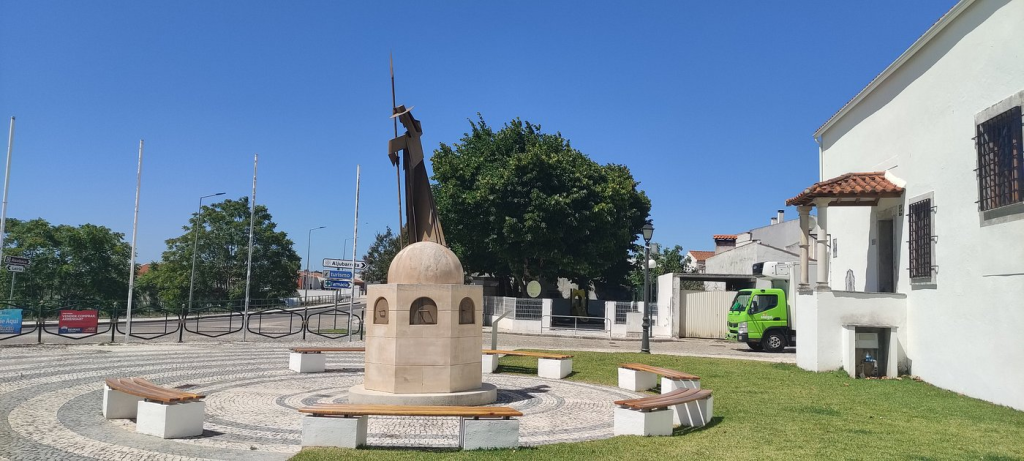
Today, Dona Brites remains an icon of Portuguese identity. She is celebrated in art, in statues, and in the hearts of those in Aljubarrota, where traditional sweet loaves are still sometimes baked in the shape of her legendary shovel.
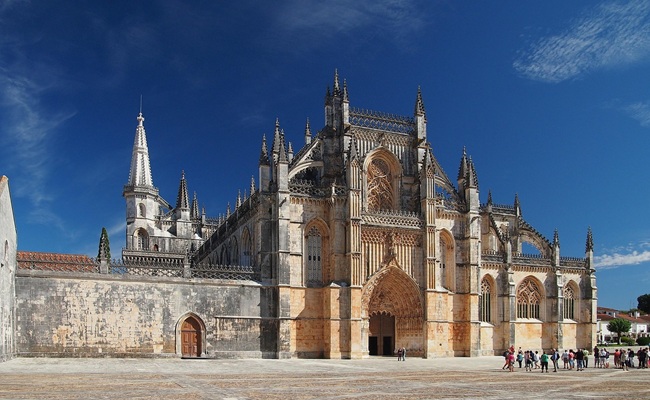
The Battle of Aljubarrota established the Aviz dynasty and secured Portugal’s borders for centuries. It is commemorated by the magnificent Monastery of Batalha, a masterpiece of Gothic architecture built by King João I on the site of the victory. But just as important as that grand stone monastery is the humble, wooden shovel of Dona Brites, reminding us that a nation’s freedom is only as strong as the will of its people to defend it.